
“Ancient Wisdom for Modern Life”
Vedic Cultural Activities: The Hidden Spiritual Meaning of Indian Rituals
The Science Behind Vedic Cultural Activities in Indian Festivals
Indian festivals are far more than dates on a calendar; they are profound alignments of cosmic energy, seasonal transitions, and ancestral wisdom. Across India, millions participate in vibrant cultural activities during celebrations like Navratri, Diwali, and Ganesh Chaturthi.
While these rituals are often viewed through the lens of devotion, the ancient Vedic scriptures reveal that festival activities are built on a precise spiritual and psychological science. Let’s explore the hidden layers of India’s most cherished festive traditions and learn how you can consciously integrate these Vedic practices into your life to elevate the energy of your modern living space.
1. The Geometry of Invitation: The Vedic Science of Rangoli
During festivals like Diwali, the entrance of almost every Indian home is adorned with vibrant geometric patterns known as Rangoli or Kolam.
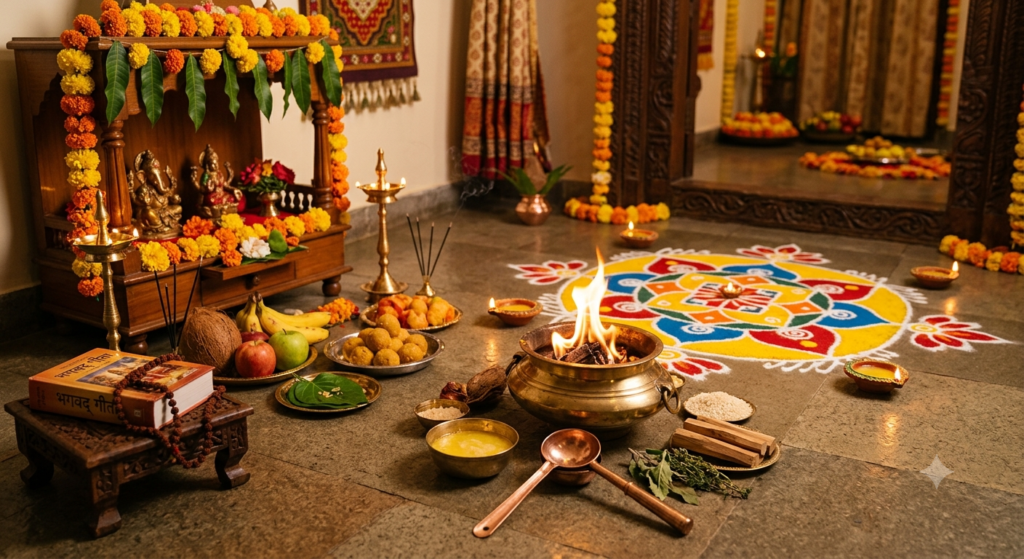
In the Vedic tradition, Rangoli is not merely decorative; it functions as an energetic grid, or a simplified Yantra (a sacred geometric design used in meditation and worship).
- Symmetry and the Brain: The human mind naturally seeks patterns. When you view a perfectly symmetrical Rangoli, it creates an instantaneous sense of calm and mental equilibrium.
- Energy Grounding: Ancient scriptures suggest that the complex, unbroken lines of traditional powder art catch and diffuse negative or scattered environmental energies before they can enter the household.
- Material Power: Traditionally created using rice flour, turmeric, and natural pigments, Rangoli also serves as a beautiful act of Bhuta Yajna—the Vedic practice of feeding smaller living creatures like ants and birds, fostering harmony with all forms of life.
2. Igniting the Inner Light: Deepdaan and the Element of Agni
Lighting clay lamps, or diyas, is the quintessential action that gives Diwali its name. The practice of Deepdaan (gifting or lighting lamps) is deeply rooted in the Agni Purana.
In Vedic philosophy, light represents Jnana (pure, untainted knowledge), while darkness represents Ajnana (ignorance). By lighting a lamp, you are physically manifesting a spiritual reality: the triumph of absolute truth over illusion.
- The Choice of Fuel: The Vedas highly recommend using pure cow ghee or cold-pressed sesame oil. When burned, ghee emits subtle, positive vibrations that purify the Prana (life force energy) in the surrounding air.
- The Cotton Wick: The wick symbolizes the human ego. As the oil (our material desires and attachments) is slowly consumed by the flame of spiritual practice, the ego is completely dissolved, leaving behind pure illumination.
3. Cleansing the Atmospheric Grid: Homa and Yajna
From minor household gatherings to massive temple events, the Homa (sacred fire ritual) is central to almost every major Indian cultural event.
The architecture of a Vedic fire ritual is a sophisticated blend of sound, intention, and elemental purification. When specific herbs, dry wood, and ghee are offered into a sanctified copper Havan Kund, it triggers an immediate molecular change in the room’s atmosphere.
- Air Purification: Medical studies on traditional Havans suggest that the combustion of medicinal woods (like sandalwood and mango wood) alongside herbs significantly reduces ambient airborne bacteria.
- The Sound Current: The simultaneous chanting of Sanskrit mantras acts as a sound-healing session. Because Sanskrit words are structured around precise phonic vibrations, they stimulate the hypothalamus and pineal glands, triggering deep relaxation and heightened focus.
4. Sonic Healing: The Power of Bhajans and Community Chanting
During festivals like Ganesh Chaturthi and Navratri, nights are filled with community singing, Bhajans, and traditional dances like Garba.
The Sama Veda explains that music is a direct bridge to the divine. When groups of individuals gather to sing names of the divine in unison, it creates a phenomenon known as collective coherence. The individual, scattered mental frequencies of the crowd align into a singular, high-vibrational energy field. This collective joy effectively dissolves micro-stresses, leaving participants feeling emotionally grounded and spiritually elevated long after the festival concludes.
How to Integrate Authentic Vedic Rituals Into Your Home
You don’t need grand arrangements to experience the true essence of these cultural activities. Here is a simple, structured approach to practicing mindful Vedic rituals in your home:
1.Purify the Physical Space:Early Morning.
Declutter your space and cleanse the floor with water infused with a pinch of rock salt or turmeric to clear out stagnant energy.
2.Establish a Sacred Threshold:Before Midday.
Draw a simple, symmetrical freehand design at your entrance using rice flour or natural colors to anchor positive intentions.
3.Perform Deepdaan:At Dusk.
Light a pure ghee or sesame oil diya in the northeast corner (Ishan Kona) of your home, keeping your mind focused on inviting clarity and wisdom.
4.Engage with Sacred Sound:Evening Meditation.
Spend 10 to 15 minutes chanting a simple mantra or quietly reading a chapter from a sacred scripture, like the Bhagavad Gita, to integrate the quiet energy of the day.
Frequently Asked Questions (FAQs)
Q1: Why is rice flour traditionally used for making Rangoli?
A: Rice flour represents prosperity and acts as a compassionate offering to birds and insects (Bhuta Yajna). Scripturally, it symbolizes the interconnectedness of all living beings and ensures that our cultural celebrations do no harm to nature.
Q2: Is there a specific scientific reason to use clay diyas instead of metals?
A: Clay (Prithvi element) retains heat beautifully and interacts naturally with organic oils. The combination of earth (clay), fuel (ghee), and fire (Agni) balances the elemental energies of your home much more organically than synthetic or highly reflective processed metals.
Q3: Can reading sacred Vedic scriptures be considered a festival activity?
A: Absolutely. In fact, reading text like the Bhagavad Gita or Upanishads is classified as Swadhyaya (self-study), which is considered the highest form of mental purification (Jnana Yajna) in the Vedic tradition.
Q4: What is the ideal direction to face while performing a household puja?
A: The Vedas recommend facing East or North. The East is associated with the rising sun, new beginnings, and vibrant energy, while the North is linked to absolute stability and spiritual growth.