
“Ancient Wisdom for Modern Life”
Krishna Janmashtami 2026: Date, Story, Rituals and Significance
Krishna Janmashtami 2026 – Every year, somewhere between the last showers of monsoon and the first hint of autumn, India waits for midnight. Temples fill, cradles are decorated, conch shells are blown, and the name of one god is chanted louder than any other — Krishna. This is Janmashtami, the birthday of Lord Krishna, one of the most beloved and most celebrated festivals in the Hindu calendar.
In 2026, Krishna Janmashtami falls on Friday, 4 September for most households following the Smarta tradition, while ISKCON and most Vaishnava temples will observe it a day later, on Saturday, 5 September. Both dates are correct — the difference comes down to which astrological detail each tradition prioritizes, and we’ll explain exactly why below.
Whether you’re planning to fast, visit a temple, or simply want to understand why this festival carries so much weight in Indian culture, here’s everything you need to know.
When Is Krishna Janmashtami in 2026?
Krishna Janmashtami is calculated using the lunar calendar, not the Gregorian one, which is why the date shifts every year. The festival falls on the Ashtami (eighth day) of Krishna Paksha (the waning phase of the moon) in the Hindu month of Bhadrapada.
For 2026:
- Ashtami Tithi begins around mid-morning on 4 September and continues until midnight going into 5 September.
- Nishita Kaal, the most auspicious midnight window for puja, falls close to midnight on the night of 4–5 September.
- Smarta households (most families observing the festival at home) celebrate on 4 September.
- ISKCON and Vaishnava temples celebrate on 5 September, since their tradition prioritizes the moment when Ashtami aligns with Rohini Nakshatra at sunrise rather than at midnight.
If you’re unsure which day to follow, go with whichever tradition your family or local temple usually observes — both are considered spiritually complete.
The Story Behind Janmashtami
To understand why an entire nation waits up till midnight for this festival, you have to go back over 5,000 years to a prison cell in Mathura.
King Kansa, the tyrannical ruler of Mathura, had imprisoned his own sister Devaki and her husband Vasudeva after hearing a prophecy: her eighth son would be the one to kill him. One by one, Kansa murdered each child born to the couple — until the eighth child arrived on a stormy, thundering night.
That child was Krishna, believed to be the eighth avatar of Lord Vishnu, born specifically to end Kansa’s reign of terror and restore dharma (righteousness) to the world.
As the legend goes, the moment Krishna was born, the prison guards fell into a mysterious sleep and the chains binding Vasudeva loosened on their own. Guided by divine instinct, Vasudeva carried the infant Krishna across the flooding Yamuna river to Gokul, where he was secretly exchanged with a baby girl born the same night to Yashoda and Nanda. Kansa, unaware of the switch, believed the prophecy had failed.
Krishna grew up in Gokul and Vrindavan as a mischievous, butter-stealing, flute-playing cowherd — beloved by everyone around him — before eventually returning to Mathura years later to fulfill the prophecy and defeat Kansa.
This story isn’t just mythology to most Hindus — it’s considered a literal, historical event, and it forms the emotional core of why Janmashtami is celebrated with such intensity, especially in Mathura and Vrindavan, the very towns where these events are believed to have unfolded.
How Janmashtami Is Celebrated
Janmashtami celebrations vary by region, but a few rituals remain consistent across India:
1. Fasting (Vrat)
Devotees observe a day-long fast, often abstaining from grains entirely and eating only fruits, milk, and specific fasting-friendly foods like sabudana (tapioca) and kuttu flour. The fast is broken the next morning after the Ashtami Tithi ends.
2. Midnight Puja
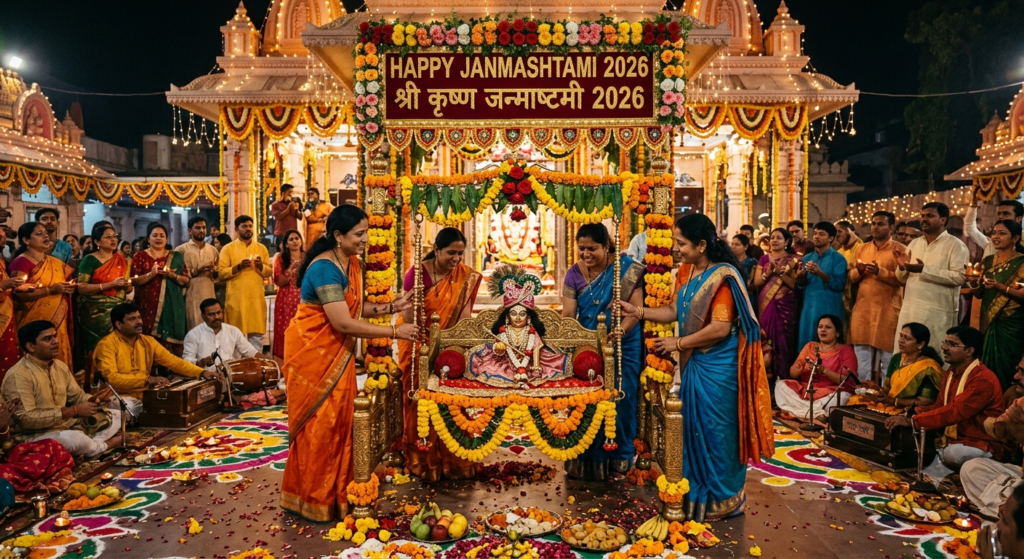
Since Krishna is believed to have been born at midnight, the main ritual — the Nishita Kaal puja — happens right around that hour. An idol or image of baby Krishna (often called Bal Gopal or Laddoo Gopal) is bathed, dressed, and placed in a decorated cradle. Devotees rock the cradle, blow conch shells, and sing devotional songs to mark the moment of birth.
3. Dahi Handi
Particularly popular in Maharashtra, this is a playful reenactment of young Krishna’s love for stolen butter and curd. Teams of young men form human pyramids to reach and break a pot (handi) of curd hung high above the street — a tradition that has today turned into a competitive, almost sport-like spectacle in cities like Mumbai and Pune.
4. Ras Leela
In regions like Mathura, Vrindavan, and parts of the Northeast, traditional dance-dramas called Ras Leela reenact scenes from Krishna’s youth — his playful pranks, his devotion to Radha, and his divine exploits — performed by local troupes late into the night.
5. Temple Decorations and Jhankis
Homes and temples are decorated elaborately, often with small dioramas (jhankis) depicting scenes from Krishna’s life. In Mathura’s Krishna Janmabhoomi temple, believed to mark his exact birthplace, and in Vrindavan’s Banke Bihari and ISKCON temples, celebrations draw devotees from across the world.
Why Krishna Janmashtami Still Matters
Janmashtami is more than a religious observance — it’s a cultural anchor. Krishna is one of the most multi-dimensional figures in Hindu tradition: a mischievous child, a devoted friend, a skilled diplomat, a warrior, and — most significantly — the teacher of the Bhagavad Gita, the philosophical dialogue at the heart of the Mahabharata that continues to shape Indian thought on duty, purpose, and detachment.
This duality is part of why Krishna resonates so widely. He is playful enough to be loved like a child and profound enough to be revered as a philosopher-god. Janmashtami captures both sides — the joyous, almost carnival-like energy of Dahi Handi alongside the quiet devotion of midnight prayer.
It’s also worth noting that Janmashtami is celebrated with real regional diversity — from Iskcon temples across the world holding all-night kirtans, to Manipur’s unique Krishna traditions, to Gujarat and Rajasthan’s elaborate Jhulan Yatra swing festivities that lead up to it. Few festivals manage to hold together such a wide spectrum of expression under one shared story.
A Few Lesser-Known Facts
- Janmashtami 2026 marks what many traditions count as the 5,253rd birth anniversary of Lord Krishna.
- The fast observed on this day is considered spiritually equivalent, in some traditions, to giving away millions of cows in charity — a reflection of how much merit (punya) it’s believed to carry.
- Krishna is worshipped under many names — Govinda, Gopal, Madhava, Keshava, Shyam — each tied to a different phase or story from his life.
- Dahi Handi has grown so large in Mumbai that it now involves prize money, sponsorships, and professional “Govinda” teams, similar to a sporting event.
Final Thoughts
Krishna Janmashtami is a festival that manages to be many things at once — a solemn spiritual observance, a joyous street celebration, and a reminder of one of Hinduism’s richest philosophical traditions. Whether you’re fasting quietly at home or watching a Dahi Handi pyramid collapse into a fountain of curd, the spirit behind it remains the same: the celebration of a life that has shaped Indian culture for over five thousand years.
As 4 September approaches, it’s worth pausing to remember that Janmashtami isn’t just about mythology — it’s a living tradition, still practiced, still evolving, and still deeply woven into the identity of a billion people.
Stay tuned to Vaydik Cosmos for more explorations of India’s festivals, myths, and the timeless wisdom behind them.