
“Ancient Wisdom for Modern Life”
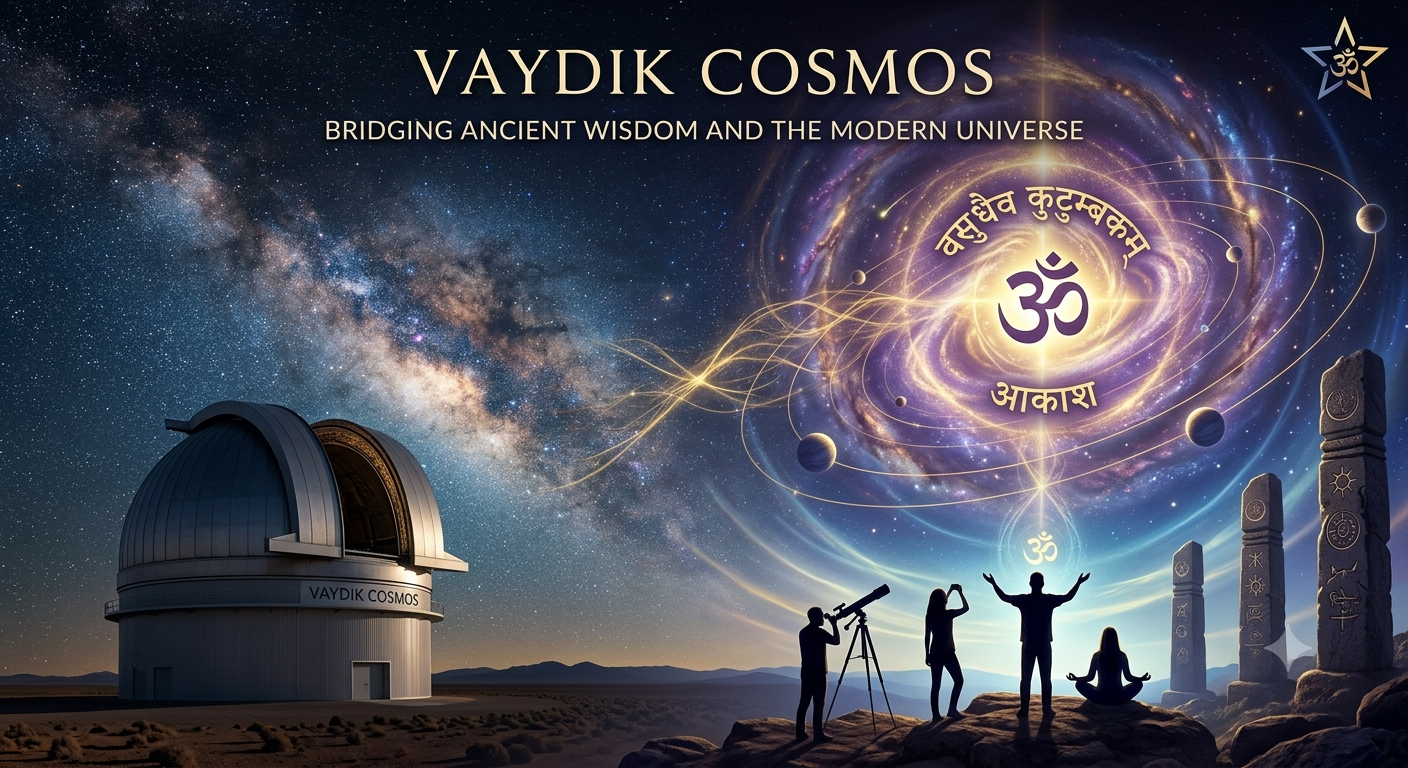
Bridging Ancient Wisdom and the Modern Universe: Why the Cosmos Calls Us
Have you ever looked up at a clear, star-filled night sky and felt an overwhelming sense of connection—a quiet realization that you aren’t just in the universe, but an integral part of it?
For centuries, humanity has stared into the dark expanse asking the same fundamental questions: Where do we come from? What is our place in this vast cosmic design?
While modern astrophysics uses state-of-the-art telescopes and mathematical models to decode the physical structure of space, the ancient Vedic traditions explored these very same truths through deep meditation, philosophical inquiry, and precise observational astronomy. At Vaydik Cosmos, we believe that true understanding lies at the intersection of both.
The Vedic Vision of Space and Time
Modern science recently amazed the world by confirming that the universe is roughly 13.8 billion years old, expanding and cycling through immense epochs. Interestingly, long before modern instruments existed, ancient Vedic texts described time on a breathtaking, cyclical scale.
- Cyclic Universes: Concepts like Srishti (creation), Sthiti (preservation), and Pralaya (dissolution) mirror theoretical physics concepts like the “Big Bounce” and cyclical cosmological models.
- Macrocosm and Microcosm: The foundational principle Yatha Pinde Tatha Brahmande (“As is the individual, so is the universe”) suggests that the laws governing the farthest galaxies are mirrored right here within human consciousness.
Science and Spirituality: Two Sides of the Same Coin
It’s easy to view modern astronomy and ancient philosophy as opposing forces, but they are actually complementary lenses viewing the same reality.
| Modern Astrophysics | Vedic Perspective | The Shared Truth |
| Cosmic Web & Quantum Entanglement | Vasudhaiva Kutumbakam & Interconnectedness | Everything in existence is deeply linked. |
| Stardust (Carbon, Nitrogen, Iron in our cells) | Pancha Mahabhuta (The Five Elements) | We are physically made of cosmic material. |
| The Big Bang & Expanding Space | Brahmand (Expanding Universe from a cosmic point/seed) | The universe is dynamic, evolving, and endless. |
When Carl Sagan famously said, “We are a way for the cosmos to know itself,” he was echoing an intuition that Vedic rishis (seers) articulated thousands of years ago: observing the stars is ultimately a journey of self-discovery.
Bringing the Cosmic Perspective into Daily Life
Understanding the vastness of the universe isn’t just an academic exercise—it changes how we live every single day.
- Shift Your Perspective: Remembering the scale of the cosmos helps dissolve daily stress. Small anxieties fade when viewed against the backdrop of billions of light-years.
- Cultivate Wonder: Spend five minutes tonight looking at the stars or reading about a recent NASA image. Let yourself feel awe.
- Recognize Unity: Realizing that the same energy fueling distant stars flows through us encourages empathy, mindfulness, and respect for all living beings.
“The sky is not the limit; it is our origin.”
Join the Journey at Vaydik Cosmos
At Vaydik Cosmos, our mission is to explore these profound connections—unpacking space exploration, deep-sky phenomena, and Vedic philosophy in ways that inspire, educate, and elevate.
Whether you’re an astronomy enthusiast, a seeker of ancient wisdom, or simply someone who loves looking up, you’ve found your community.
What cosmic topic should we explore next?
Deep-dive into cosmic time cycles (Yugas), quantum physics and consciousness, or the life cycle of stars? Let us know in the comments below!